Kinematic Viscosity Converter: cSt, $m^2/s$, Stokes & US Units
When I am preparing a Computational Fluid Dynamics (CFD) simulation or calculating the Reynolds number for a complex piping system, the material property stage is often where the most persistent errors occur. A lubricant data sheet might provide kinematic viscosity in centistokes (cSt), but my solver whether it’s OpenFOAM or Ansys almost certainly requires SI units like square meters per second ($m^2/s$). Manually shifting decimal points for these conversions is a high-risk task where one misplaced zero can lead to non-physical results or a total failure of the solver to converge.
What I find indispensable for these preliminary checks is the ScholarTool Kinematic Viscosity Converter. It is a deterministic, browser-local utility designed to harmonize fluid resistance units across global standards. Whether I am working with SI, Metric, or US Customary measurements, this tool ensures that my property assumptions are mathematically sound and my proprietary data remains private.
What Kinematic Viscosity Helps You Do
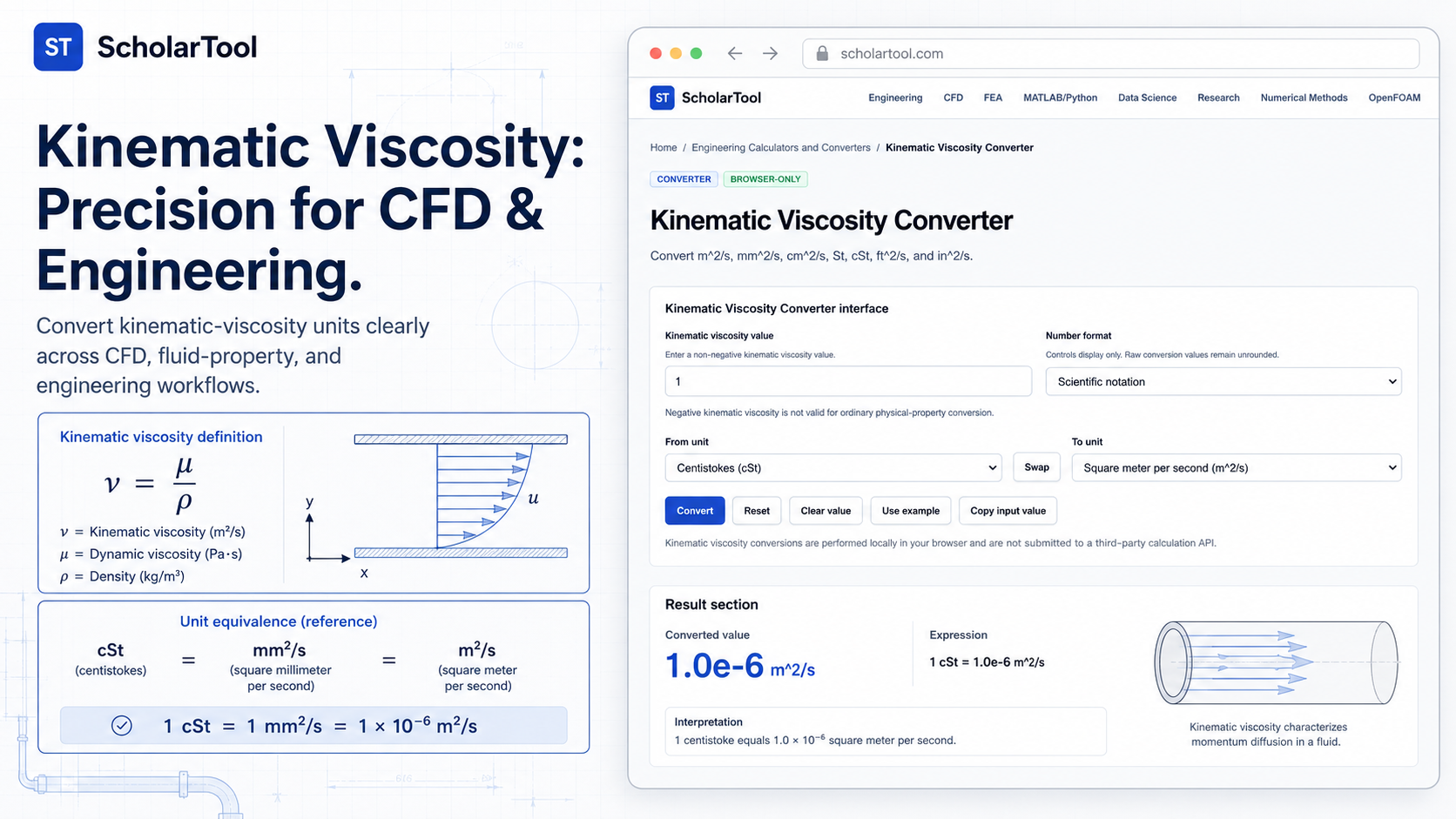
In technical terms, kinematic viscosity ($\nu$) represents a fluid’s resistance to flow under the influence of gravity. As the ScholarTool interface visually demonstrates with its technical diagram, $\nu$ is the ratio of dynamic viscosity ($\mu$) to the fluid’s density ($\rho$). While dynamic viscosity measures internal friction, kinematic viscosity is often described as “diffusivity of momentum”.
The primary purpose of this converter is to provide a unified environment where diverse units ranging from Stokes (St) used in classical mechanics to square inches per second ($in^2/s$) found in legacy US manufacturing can be harmonized. As I’ve observed in machine design principles, selecting the correct viscosity is the single most important factor for determining the stability of hydrodynamic bearings and flow regimes.
A Comparative Perspective: SI vs. Industry Standards
From a comparative perspective, industry standards often diverge from academic requirements. Most commercial lubricants are rated in centistokes at specific temperatures (40°C or 100°C), while nearly all engineering formulas require the $m^2/s$ equivalent.
I find the ScholarTool interface particularly helpful here because it treats centistokes and square millimeters per second ($mm^2/s$) as numerically equal, which is a vital “sanity check” for practitioners. Furthermore, by providing a side-by-side comparison of Metric and US Customary units (like $ft^2/s$), the tool helps bridge the gap between manufacturer specs and modern simulation environments without requiring multiple manual calculations.
Inputs You Can Use
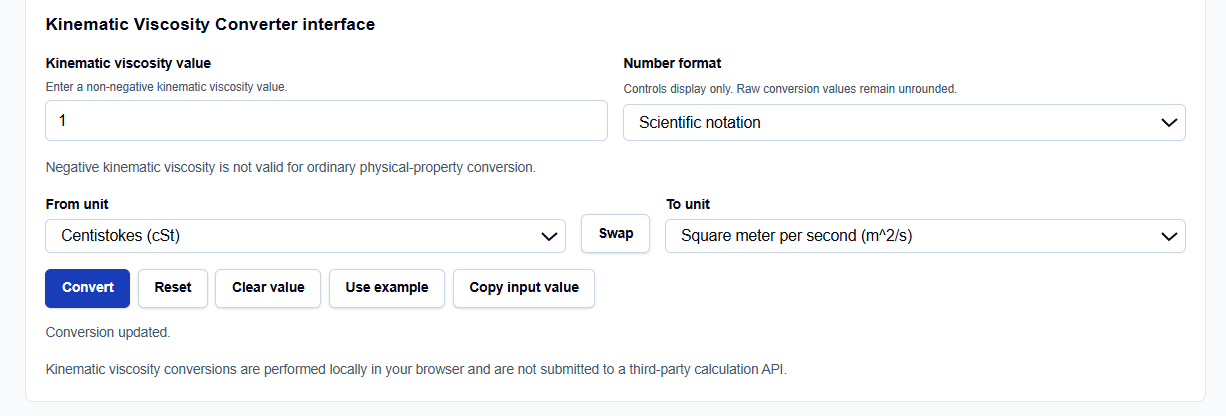
The interface is built with a logical, “config-first” layout that allows you to set your parameters before you trigger a result.
Value and Formatting
I start by entering the Kinematic viscosity value. I have noticed that this field is highly flexible; you can enter standard decimals or use scientific notation like 1e-6. Crucially, the tool enforces a non-negative constraint; negative viscosity is not valid for physical-property conversion. You can also choose the Number format to control display precision ranging from 2 to 8 decimal places or up to 6 significant figures.
Unit Selection
The From unit and To unit dropdowns cover seven essential standards, including SI ($m^2/s$), CGS (St, cSt), and US Customary ($ft^2/s, in^2/s$). If I accidentally enter them in the wrong order, I simply click the Swap button to reverse the logic instantly.
How I Use the Tool
My typical workflow begins by entering the data from a material data sheet. For instance, if I am looking at a standard hydraulic oil with a viscosity of 32 cSt, I enter 32 and select centistokes as my source.
Once I click the Convert action, I appreciate the transparency of the Calculation steps. The tool provides an explicit Base-unit normalization, converting every input into square meters per second ($m^2/s$) first before translating to the target unit. This two-step process is a professional-grade approach that prevents the compounding rounding errors found in simpler calculators. If I am setting up a fresh report, I often click the Use example button to quickly verify the output format for common engineering values.
Understanding the Results
The result section provides the Primary converted value prominently at the top. However, what I find most valuable for auditing my work is the All-unit comparison table generated with every calculation.
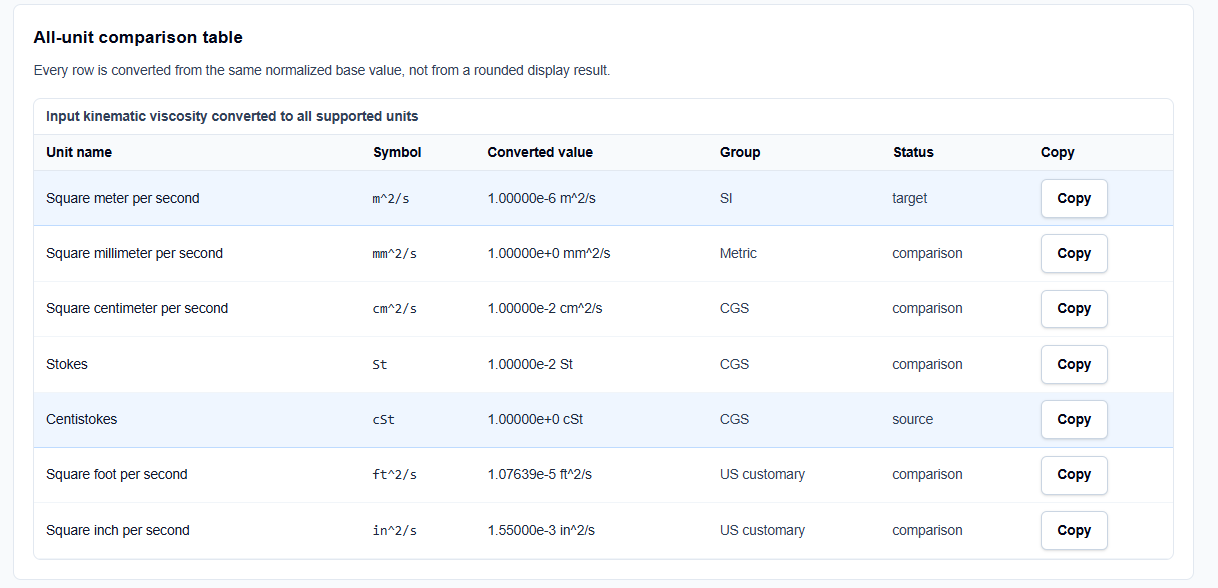
Every row in this table is converted from the same normalized $m^2/s$ value. If I am converting cSt to SI, I can glance at the table to simultaneously see the equivalent in square inches per second. I also find the Reverse conversion check helpful; it confirms that the target value translates back to the original input, providing an extra layer of confidence for my technical documentation.
A Practical Example
Suppose I am verifying the properties of water at 20°C, which is often listed as 1 cSt. I enter 1 in the value field and select Centistokes (cSt) as the source and Square meter per second (m^2/s) as the target.
The result shows that 1 cSt = 1.00000e-6 $m^2/s$. I can then use the Copy all-unit table button to archive the full suite of equivalents including the fact that this is also 1 $mm^2/s$ directly into my CFD boundary condition report.
Mistakes I Would Avoid
One common pitfall I see is confusing centistokes (cSt) with centipoise (cP). Centistokes measure kinematic viscosity, whereas centipoise measures dynamic viscosity. This converter handles kinematic values only; if you need to switch between the two, you must have the fluid density ($\rho$) and use a separate dynamic converter.
Another mistake is ignoring temperature dependence. Viscosity is not a static constant; it changes significantly with temperature. I always ensure the value I am converting corresponds to the operating temperature of my simulation or machine element.
Try the Free Kinematic Viscosity Converter
Before you hit “Initialize” on your next simulation, take a minute to verify your fluid properties. It is the fastest way to eliminate unit-based errors in your engineering reports.
Try the Kinematic Viscosity Converter here. For a complete property review, you may also find the Dynamic Viscosity Converter, Density Converter, or the Reynolds Number Calculator essential for your workflow.
FAQ
1. Is a centistoke (cSt) the same as a square millimeter per second ($mm^2/s$)?
Yes. In the metric system, these two units are numerically identical. You can verify this by using the Kinematic Viscosity Converter to translate between them.
2. Can I use this tool to convert dynamic viscosity to kinematic viscosity?
No. This is a unit converter for kinematic viscosity only. To convert from dynamic viscosity ($\mu$) to kinematic viscosity ($\nu = \mu / \rho$), you require the density of the fluid.
3. Does this tool save my proprietary fluid data?
No. All conversions are performed locally in your browser using TypeScript. Your inputs and results are never submitted to any ScholarTool server or third-party calculation API.