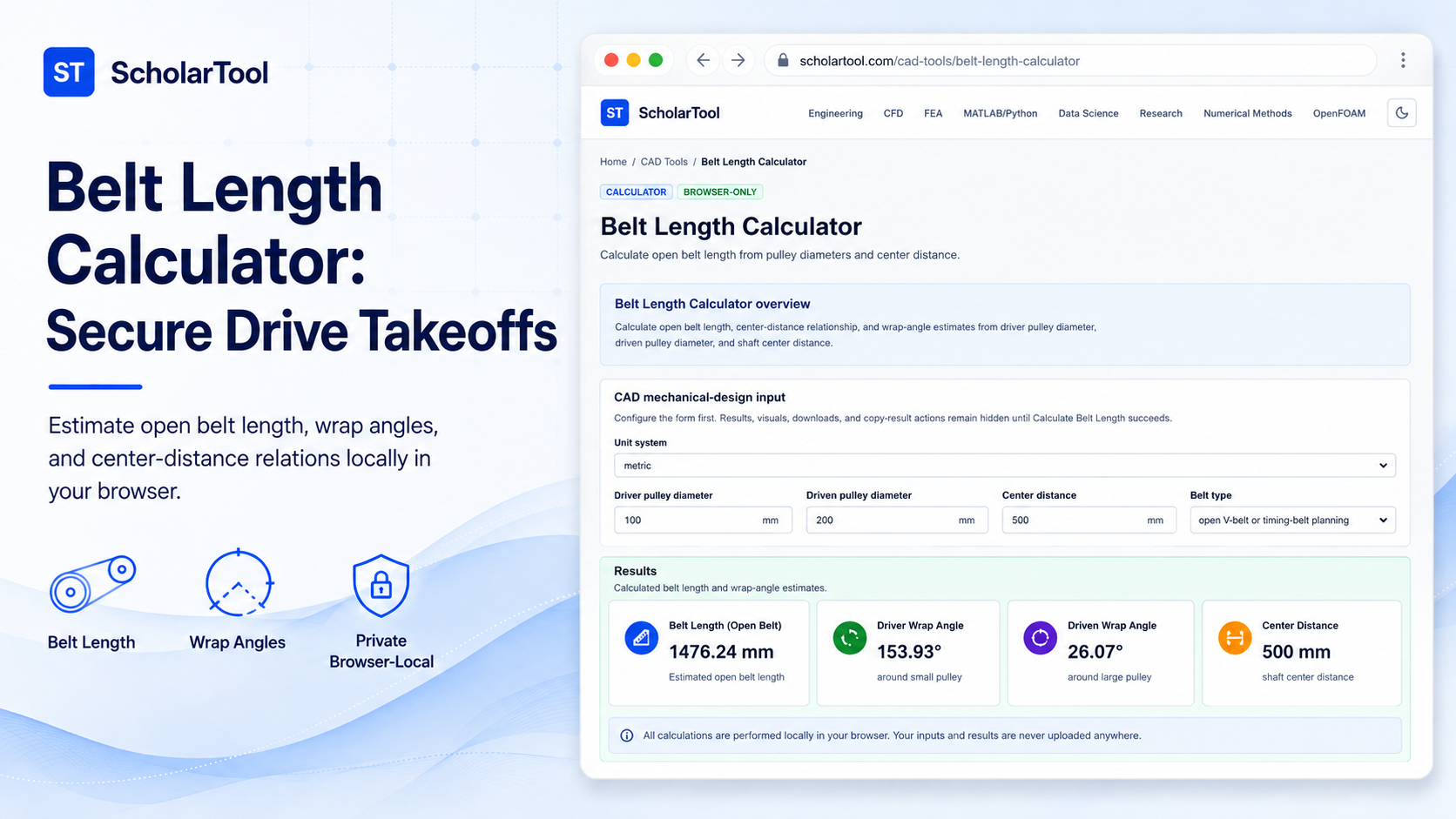
Belt Length Calculator: Open Belt & Wrap Sizer
When designing a power transmission system, laying out a belt drive is a critical point of friction. Every mechanical engineer must determine if the shaft center distance, pulley diameters, and belt length are mathematically compatible before ordering hardware or releasing drawings. Guessing these basic spatial dimensions or using rough estimations leads to loose belts, lack of tension adjustment travel, and poor wrap angles that cause slip and early drive failure.
To solve this layout bottleneck with complete browser privacy, I use the Belt Length Calculator on ScholarTool. This browser-only utility estimates open belt length and wrap angles from pulley diameters and center distance. Because all calculations run entirely in your local browser tab using client-side TypeScript, your proprietary machine coordinates are never uploaded, ensuring 100% data sovereignty.
What the Belt Length Calculator Helps You Do
This calculator acts as a steady-state drafting and spatial takeoff aid during early layout planning, pulley spacing, and belt-drive configuration. Rather than forcing you to look up approximations or build custom CAD spreadsheets, it organizes standard belt-drive geometry formulas into an auditable “math receipt”.
What I find useful here is that the tool handles the unequal pulley diameter correction factor automatically. It allows you to rapidly check if a standard belt length fits your envelope, or if a custom center distance is needed. By outputting the small and large pulley wrap angles alongside the belt length, it alerts you to potential slip or traction issues early in the design cycle.
Inputs You Can Use
The interface features a structured, configuration-first layout to ensure your dimensional assumptions are sound before solving:
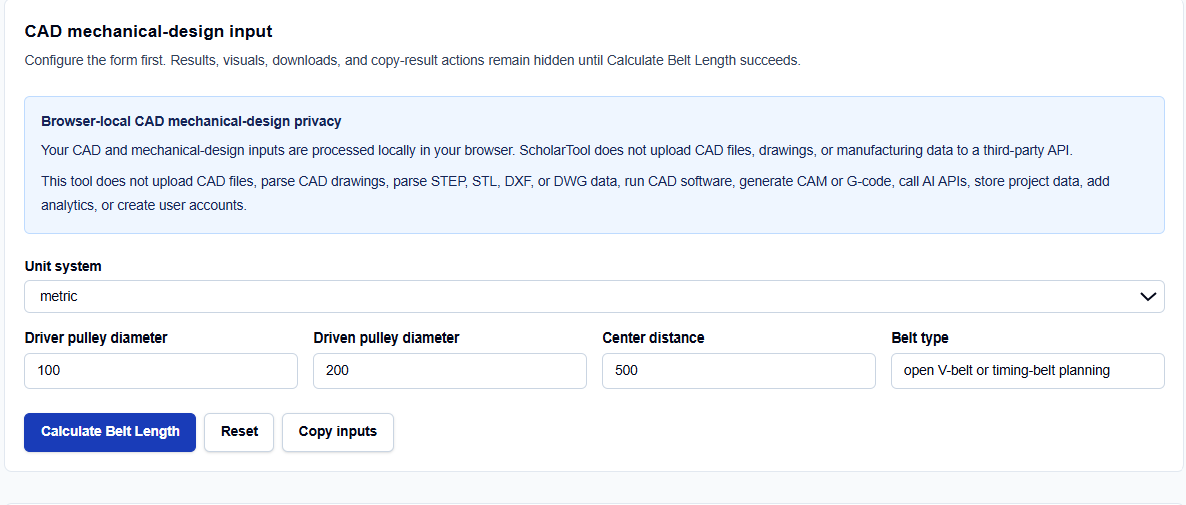
- Unit System: You can choose between metric and inch modes depending on your standard.
- Driver Pulley Diameter (d): Entered as the effective pitch diameter of the driving pulley.
- Driven Pulley Diameter (D): Entered as the effective pitch diameter of the driven pulley.
- Center Distance (C): The shaft center-to-center distance for the open belt layout.
- Belt Type Note: An optional field for flat belt, V-belt, or timing-belt planning context.
How I Use the Tool
I open the Belt Length Calculator in my browser window. First, select the correct unit system.
When I enter our raw design coordinates, I verify that we are using the pitch or effective diameters of the pulleys, rather than their absolute outer dimensions. If your data is available in this form, you can enter the driver, driven, and center distance coordinates directly. Once you select the belt type note, click Calculate Belt Length. The result section helps you verify the physical boundaries instantly. Results and downloads remain completely hidden until this action succeeds, and editing any input afterward automatically hides the output panel to prevent stale data copying.
Understanding the Results
The result section helps you verify the drive envelope by presenting several key parameters:
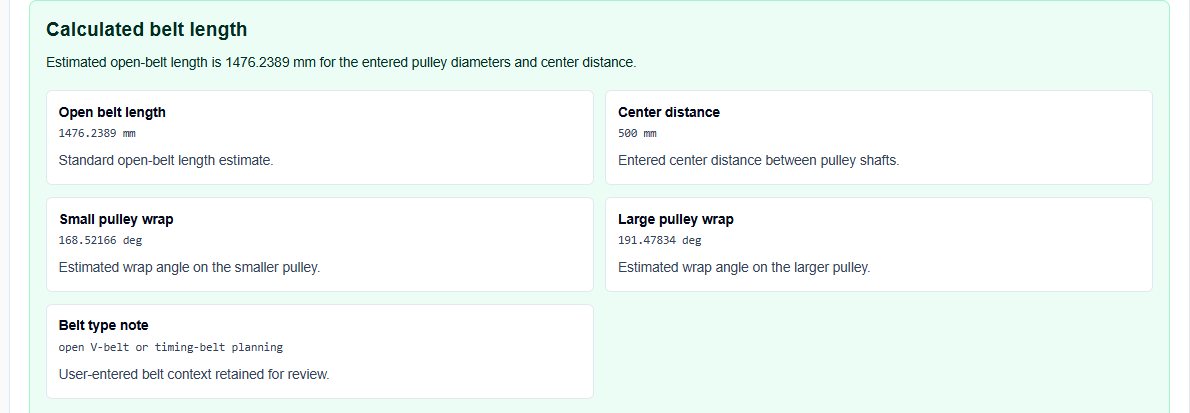
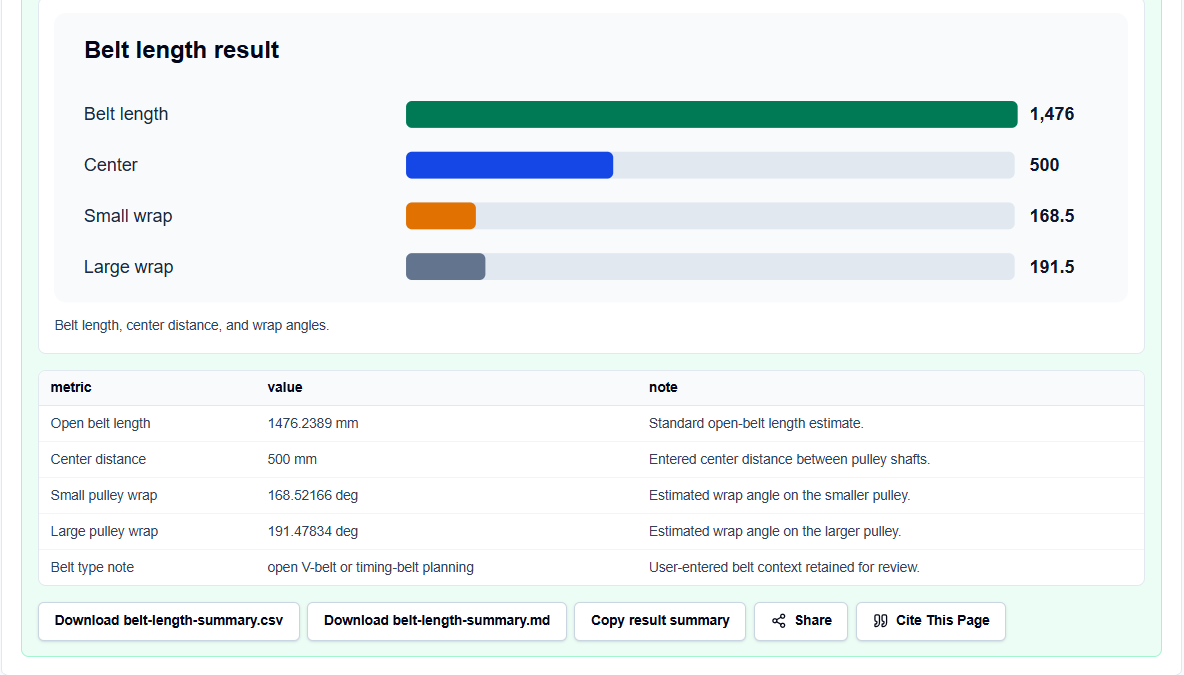
- Estimated Belt Length (L): Reports the theoretical open-belt length using the unequal-diameter correction formula.
- Small Pulley Wrap Angle: Reports the wrap angle in both radians and degrees, helping you evaluate traction boundaries.
- Large Pulley Wrap Angle: Reports the wrap angle on the larger pulley.
- Geometric Warning Flags: Renders warnings if the center distance is too short or if a severe pulley mismatch exists.
The tool also provides a clean SI unit normalization table to trace how the raw inputs were converted before formulas were applied.
A Practical Example: Sizing an Unequal Pulley Drive
Consider a typical check where we need to find the belt length for an unequal-diameter reduction drive.
We configure the inputs:
- Unit System: Metric, Belt Type: V-belt.
- Driver Pulley Diameter (d): 100 mm.
- Driven Pulley Diameter (D): 200 mm.
- Center Distance (C): 500 mm.
Upon clicking calculate, the browser-local script applies the open-belt corrected-length formula: \[L = 2C + \frac{\pi(D + d)}{2} + \frac{(D – d)^2}{4C}\] Substituting our coordinates: \[L = 1000 + 471.24 + 5 = 1476.24\text{ mm}\] The result section helps you verify an estimated belt length of approximately 1476 mm. This lets us verify physical clearance before checking standard supplier catalogs.
Mistakes I Would Avoid
One critical mistake is using the outside pulley diameter instead of the pitch diameter. Standard V-belts and timing belts ride at a specific pitch line; sizing with outside diameters will result in a belt that is too short or cannot be tensioned.
Another major pitfall is forgetting the installation and tensioning adjustment range. Always design slide slots or idlers to allow the center distance to contract for installation and expand for tensioning.
Finally, avoid ignoring the small-pulley wrap angle. If your wrap angle drops below 120 degrees due to a severe pulley diameter ratio, the belt will slip under load unless you add an idler or increase tension.
Try the Free Belt Length Calculator
To eliminate manual geometric conversion errors and secure your design coordinates, try this secure tool today.
Try the Belt Length Calculator on ScholarTool Chaining this check with our Pulley Ratio Calculator or Chain Drive Calculator completes your power transmission takeoff. You can also model keyway boundaries using our Shaft Key Calculator.
FAQ
1. Does the Belt Length Calculator support crossed belts or serpentine layouts?
No. This calculator is strictly designed for standard open-belt drives with two pulleys of equal or unequal diameters. Crossed belt drives, multi-pulley serpentine drives, belt stiffness characteristics, and dynamic tensions are unsupported and must be evaluated using specialized CAD software or supplier tools.
2. Are my proprietary machine parameters or drive coordinates uploaded to ScholarTool?
No. All entered coordinates and configurations are parsed locally within your device’s browser tab using client-side TypeScript logic. No data is transmitted to external servers, cloud databases, or third-party calculation APIs, ensuring absolute design confidentiality.
3. Why do the results clear and hide automatically if I edit an input?
This is a built-in safety guard. If you modify any parameter, unit system, or pulley diameter, the results panel automatically hides until you click “Calculate Belt Length” again. This prevents stale or inconsistent metrics from looking like reviewed engineering outputs.