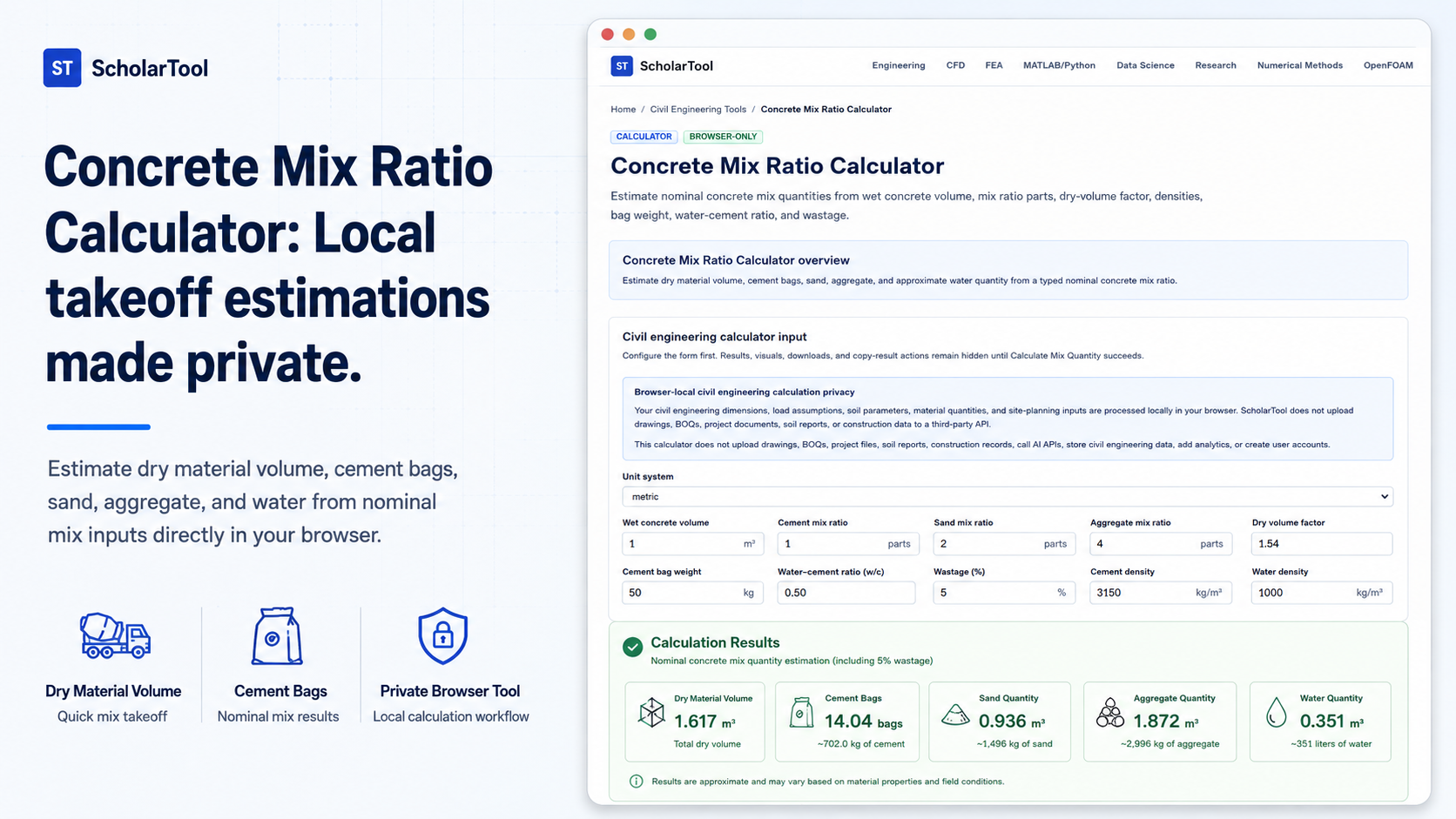
Concrete Mix Ratio Calculator: Dry Batching Estimator
When translating structural blueprints into a material procurement sheet, the “first point of friction” is translating a wet concrete volume into raw, dry ingredients. As noted in classic structural engineering handbooks, concrete is a closely proportioned mixture of binding material, fine aggregates, coarse aggregates, and water. If you guess these raw proportions without a firm “math receipt,” you risk expensive on-site shortages or wasteful ready-mix surpluses.
To bridge this gap during early estimation and planning, I use the Concrete Mix Ratio Calculator from ScholarTool. It is a deterministic, browser-local civil engineering utility designed to convert wet concrete volumes into dry batching volumes and masses. By executing all calculations locally on your device, it ensures your sensitive project dimensions, drawings, and bills of quantities (BOQs) remain completely private.
What the Concrete Mix Ratio Calculator Helps You Do
The primary purpose of this tool is to provide quick, preliminary dry-batching estimates from a given nominal mix ratio and wet volume. Rather than relying on static reference charts or unstable third-party cloud apps, the tool performs a rule-based calculation to report dry volume, cement bags, sand volume, coarse aggregate mass, and estimated water quantity.
What I find useful is that it models the physical reality of concrete batching. It uses a dry volume factor (such as the standard 1.54) to account for the compaction and void filling that occurs when dry ingredients are mixed with water. This ensures your procurement numbers are grounded in structural reality.
Inputs You Can Use
The interface is built with a clean, configuration-first layout. Before you can generate any results, you must configure the inputs:
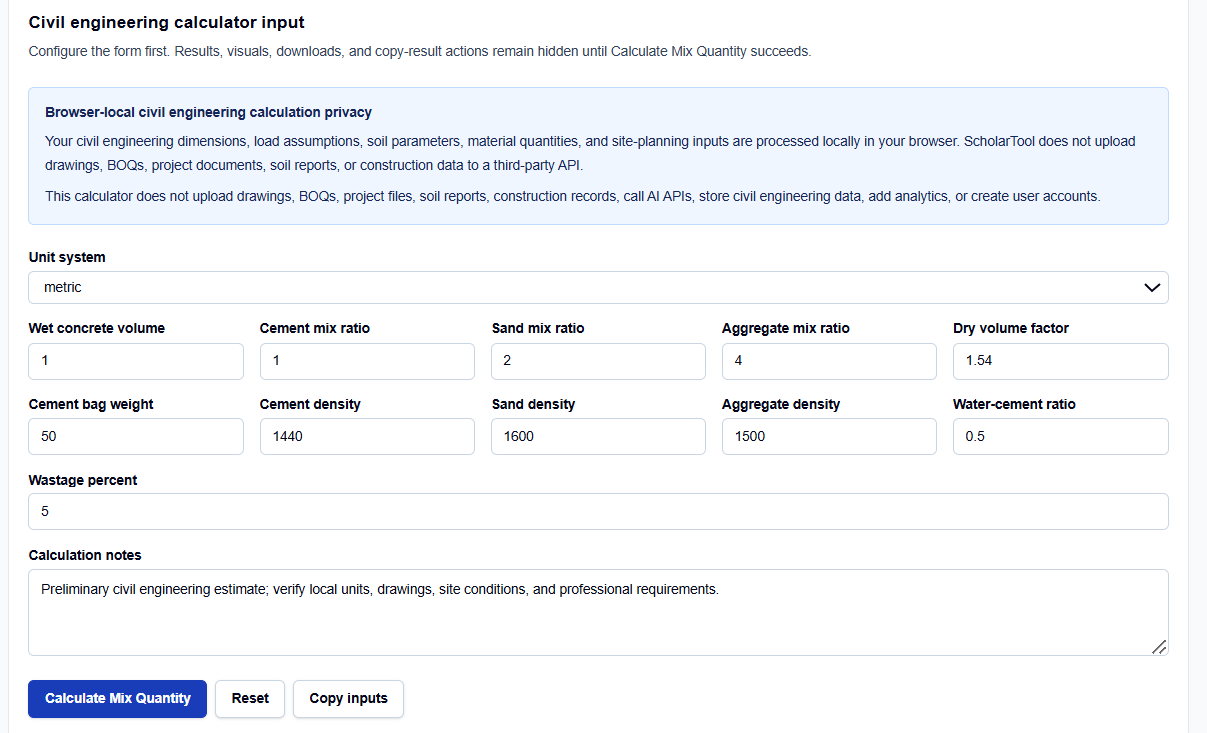
- Unit System: Toggle between metric and imperial to match your design drawings.
- Wet Concrete Volume ($V_{\text{wet}}$): Input the wet volume directly from your structural drawings or the Concrete Volume Calculator.
- Mix Ratio (Cement:Sand:Aggregate): Enter nominal parts of the mix (e.g., 1, 2, and 4) to specify the structural proportions.
- Dry Volume Factor: Set your compaction factor (default is 1.54) to represent the volumetric reduction during wet compaction.
- Material Properties: Adjust the bulk densities of cement (default 1440 $\text{kg/m}^3$), sand (default 1600 $\text{kg/m}^3$), and aggregate (default 1500 $\text{kg/m}^3$) alongside your standard cement bag weight (default 50 kg) to match local supplier characteristics.
- Water-Cement Ratio and Wastage: Set your target w/c ratio (default 0.5) and wastage percent (default 5%) to establish your safety allowance.
How I Use the Tool
My typical workflow starts as soon as the concrete takeoff is completed. I open the Concrete Mix Ratio Calculator.
I select my unit system and enter the wet volume. I adjust the mix ratio parts to reflect the structural grade specified (e.g., a standard 1:2:4 ratio for standard structural concrete works). After adjusting the densities based on local aggregate delivery tickets, I click Calculate Mix Quantity. I appreciate that all output tables and copy actions remain completely hidden until this explicit action succeeds, preventing the accidental use of stale or prefilled default data in my takeoff sheets.
Understanding the Results
Once calculated, the tool presents several structured outputs:
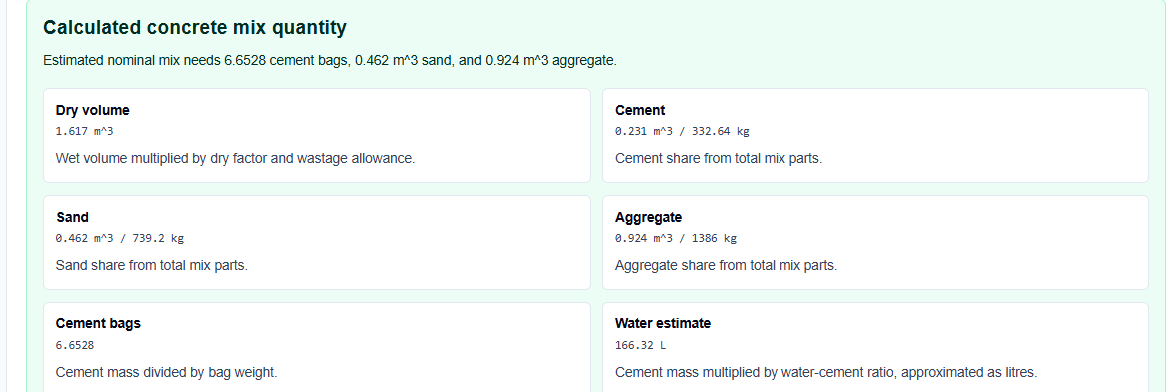
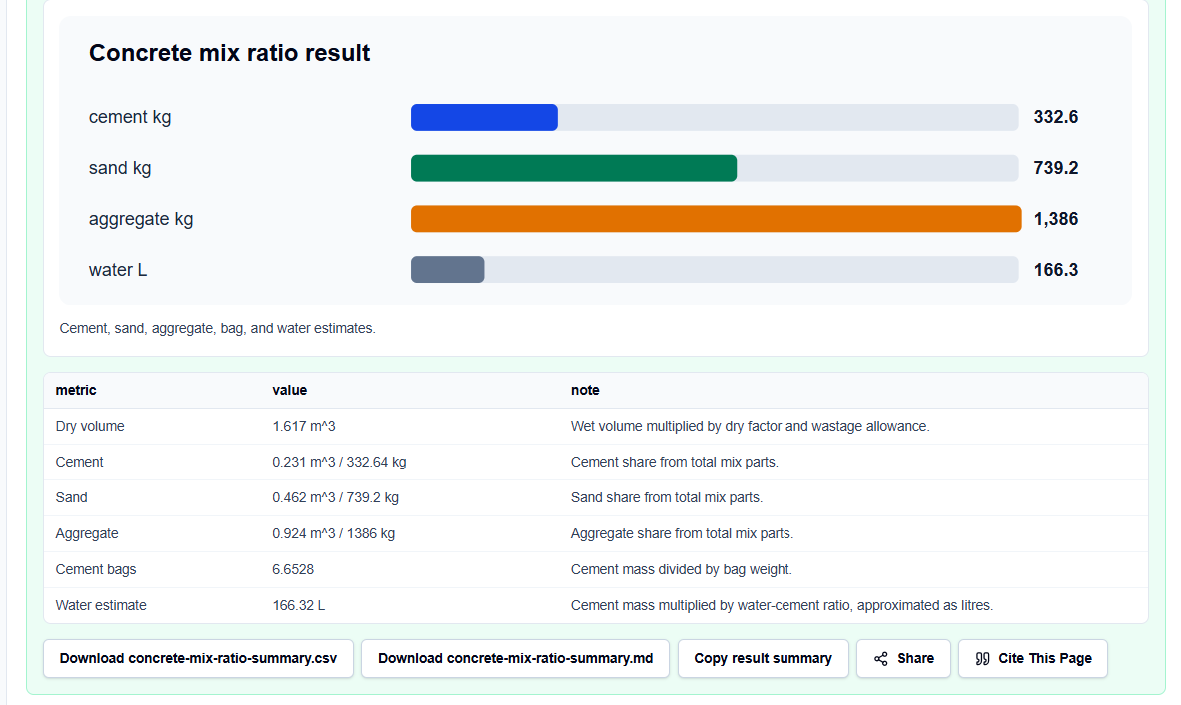
- Dry Volume ($V_{\text{dry}}$): Shows the material-estimation basis: $$V_{\text{dry}} = V_{\text{wet}} \times \text{dry factor} \times (1 + \text{wastage} / 100)$$
- Cement Bags: Converts the dry cement volume into a standard bag count based on your density and bag weight.
- Sand & Aggregate Quantities: Reports both volumetric and mass estimates to coordinate logistics.
- Water Estimate: Calculates approximate water litres based on the cement mass and your water-cement ratio. Note that this is an arithmetic planning quantity, not a mix-design recommendation.
A Practical Example: The Nominal 1:2:4 Mix
Let’s look at a realistic nominal concrete mix takeoff for a wet volume of 1 $\text{m}^3$ using a 1:2:4 ratio, a dry factor of 1.54, and a 5% wastage rate. After clicking the action button, the tool calculates: $$V_{\text{dry}} = 1 \times 1.54 \times 1.05 = 1.617\text{ m}^3$$
Splitting this into seven total parts gives a cement volume of 0.231 $\text{m}^3$, sand volume of 0.462 $\text{m}^3$, and aggregate volume of 0.924 $\text{m}^3$. Assuming a cement density of 1440 $\text{kg/m}^3$ and a 50 kg bag weight, the final cement mass is 332.64 kg, which translates to exactly 6.65 bags. Using a water-cement ratio of 0.5, the estimated water needed is 166.32 litres.
Mistakes I Would Avoid
One critical error is mixing up your dimensional units. It is common to confuse millimeters and meters on structural drawings. Entering a 150 mm slab depth as “150” in metric mode will result in massive quantity errors.
Another mistake is treating these preliminary results as a certified mix design. This calculator does not design for target compressive strength, durability, or slump, and it does not replace licensed civil and structural engineering review.
Try the Free Concrete Mix Ratio Calculator
If you want to eliminate manual batching errors and streamline your takeoff estimates, try the tool today. It is free, private, and runs entirely in your local browser.
Try the Concrete Mix Ratio Calculator on ScholarTool To complete your concrete design workflow, you can chain this estimate with the Cement Sand Aggregate Calculator or check structural volume needs with the Concrete Volume Calculator. You can also plan brickwork using the Brick Calculator or finishes with the Plaster Calculator.
FAQ
1. Is this concrete mix ratio calculator a mix design tool?
No. It estimates material quantities from nominal ratios (such as 1:2:4) and does not perform compressive strength design, durability design, slump design, or chemical admixture checks.
2. Why are the densities of the aggregates editable?
Bulk aggregate densities vary considerably depending on geological origin, grading, and moisture content. Allowing these properties to be editable lets you match supplier specifications exactly for higher accuracy.
3. Why do the results disappear when I change an input?
This is an integrated safety guard to prevent stale calculations. If you modify any parameter or ratio, the output blocks automatically hide until you click “Calculate Mix Quantity” again.