Cement Sand Aggregate Calculator: Concrete Estimator
When transitioning from structural drawing boards to material procurement, the “first point of friction” is translating a wet concrete volume into bags of cement, tons of sand, and truckloads of aggregate. As M.S. Shetty highlights in Concrete Technology, proportioning involves minimizing voids through proper aggregate grading so the cement paste can effectively lubricate and bind the mix. Guessing these quantities without a transparent “math receipt” leads to expensive on-site shortages or wasteful ready-mix surpluses.
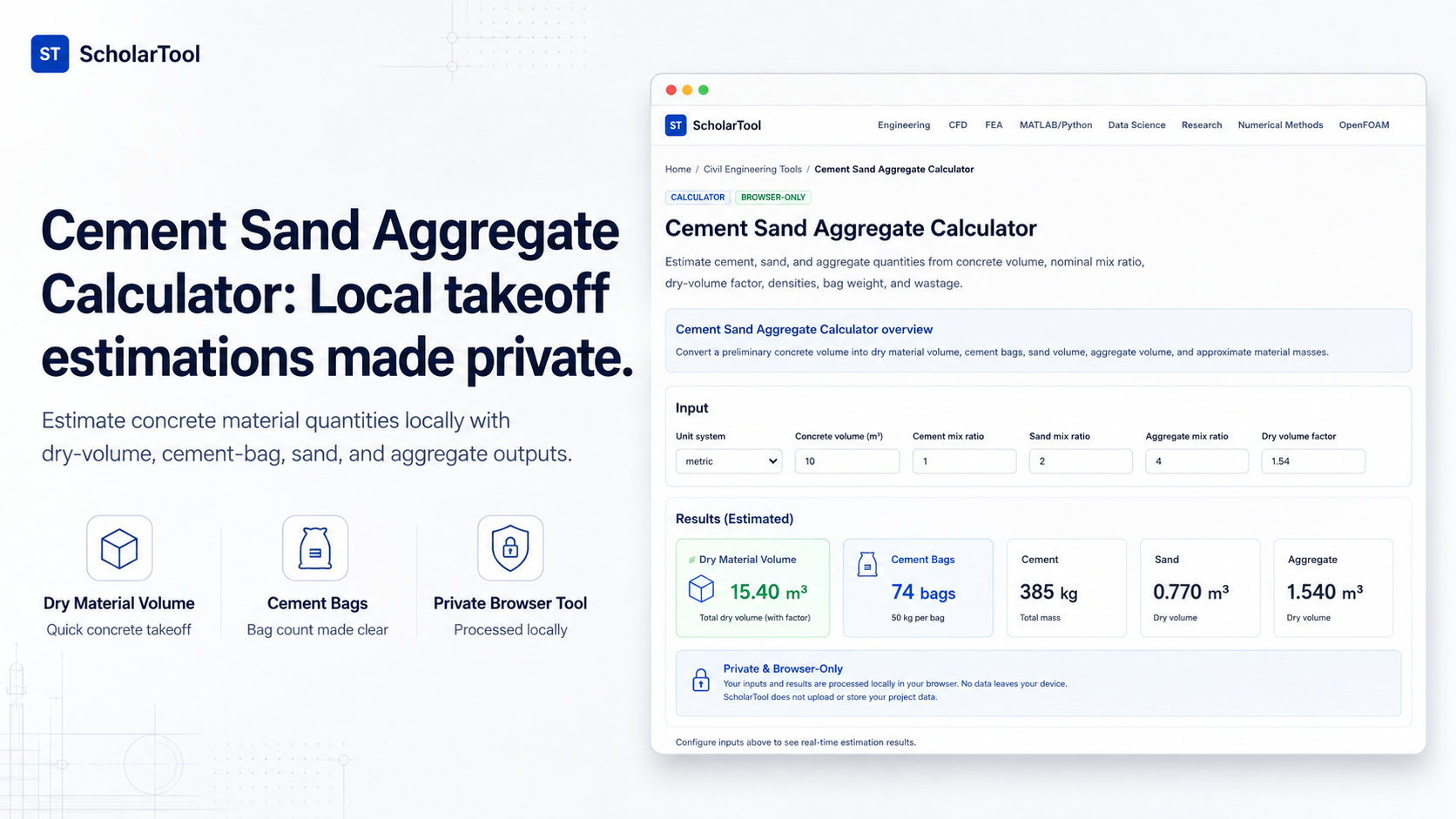
To bridge this gap during early estimation, I use the Cement Sand Aggregate Calculator on ScholarTool. It is a browser-local utility designed to convert wet concrete volumes into dry material volumes and mass estimates.
What the Cement Sand Aggregate Calculator Helps You Do
The primary purpose of this tool is to provide quick, preliminary dry-batching estimates from a given nominal mix ratio and wet volume. It performs a rule-based calculation to report dry volume, cement bags, sand volume, and aggregate volume.
What I find useful is it addresses the “privacy gap” in modern workflows. Unlike cloud utilities requiring drawing or BOQ uploads to external servers, it executes calculations locally. This safeguard ensures your proprietary variables never leave your browser.
Inputs You Can Use
The interface is designed with a clean, configuration-first layout. Before any outputs are displayed, you must define several critical parameters:
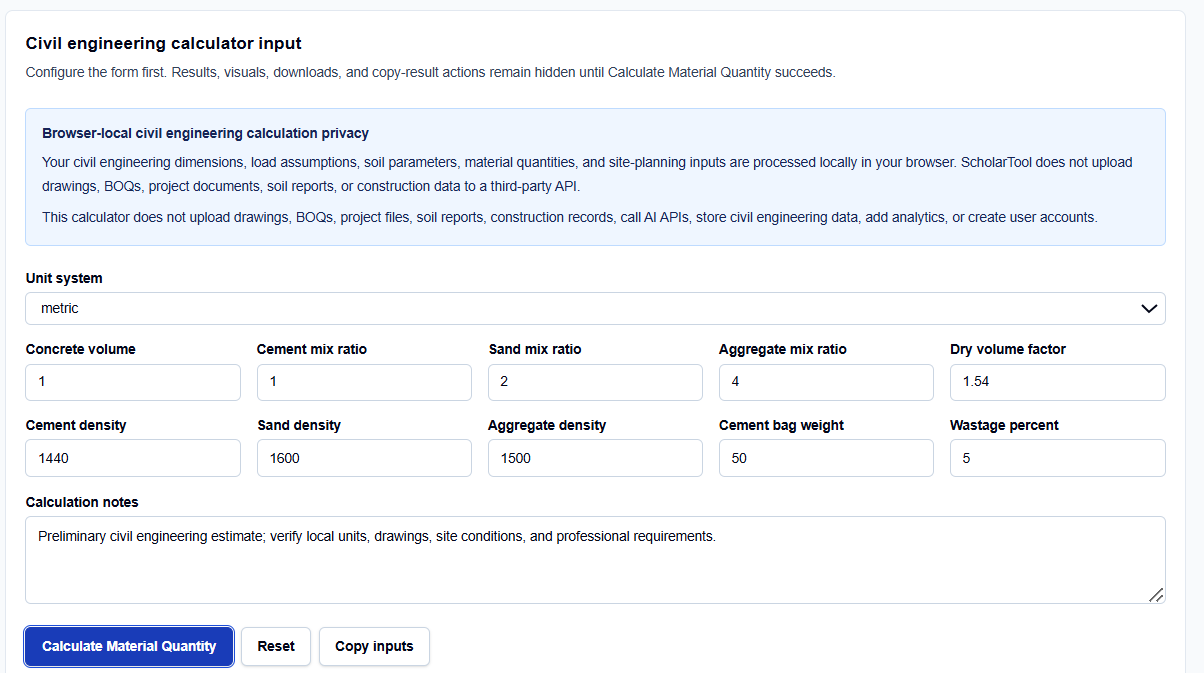
- Unit System: Select metric or imperial to match your project drawings.
- Concrete Volume: Input the wet volume from blueprints or the related Concrete Volume Calculator.
- Mix Ratio (Cement:Sand:Aggregate): Nominal parts of the mix (e.g., 1:2:4).
- Dry Volume Factor: Defaults to 1.54 to account for volume reduction during wet compaction.
- Densities: Editable densities (default 1440, 1600, 1500 $\text{kg/m}^3$) since bulk properties vary by source.
- Cement Bag Weight: Set your local standard bag weight (default 50).
- Wastage Percent: An allowance (default 5%) for transport or batching losses.
- Calculation Notes: Local text field to record design assumptions.
How I Use the Tool
In my workflow, I open the Cement Sand Aggregate Calculator once wet volumes are finalized. I select the unit system, input the wet volume, and adjust mix ratios and densities based on the supplier’s specification.
Once parameters are configured, I click Calculate Material Quantity. All results, downloads, and copy actions remain hidden until this explicit action is clicked, preventing the accidental use of default values in procurement orders.
Understanding the Results
The results section provides a transparent breakdown of your material takeoff:
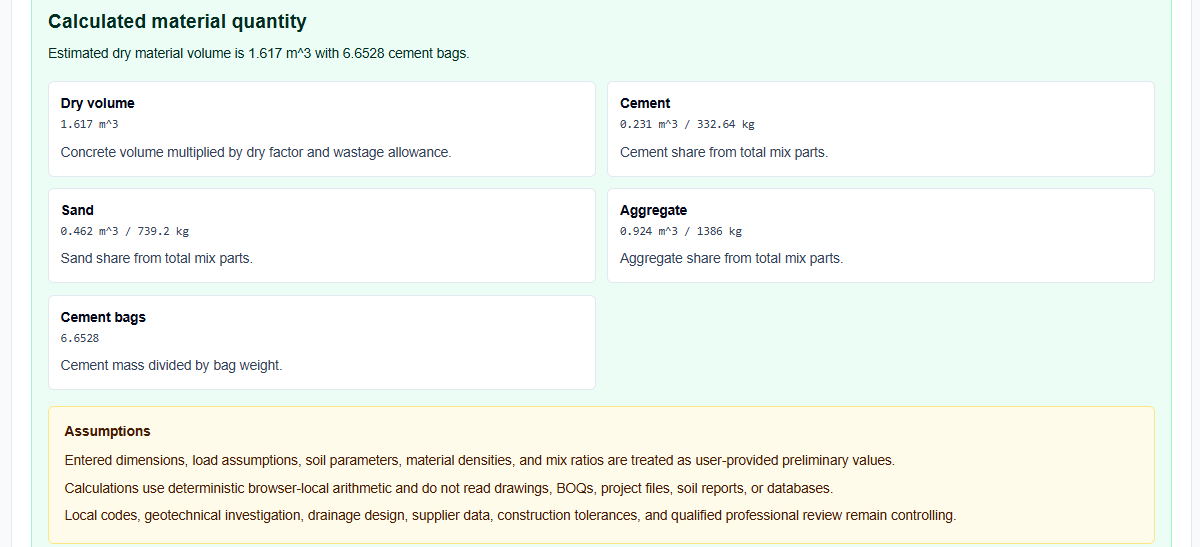
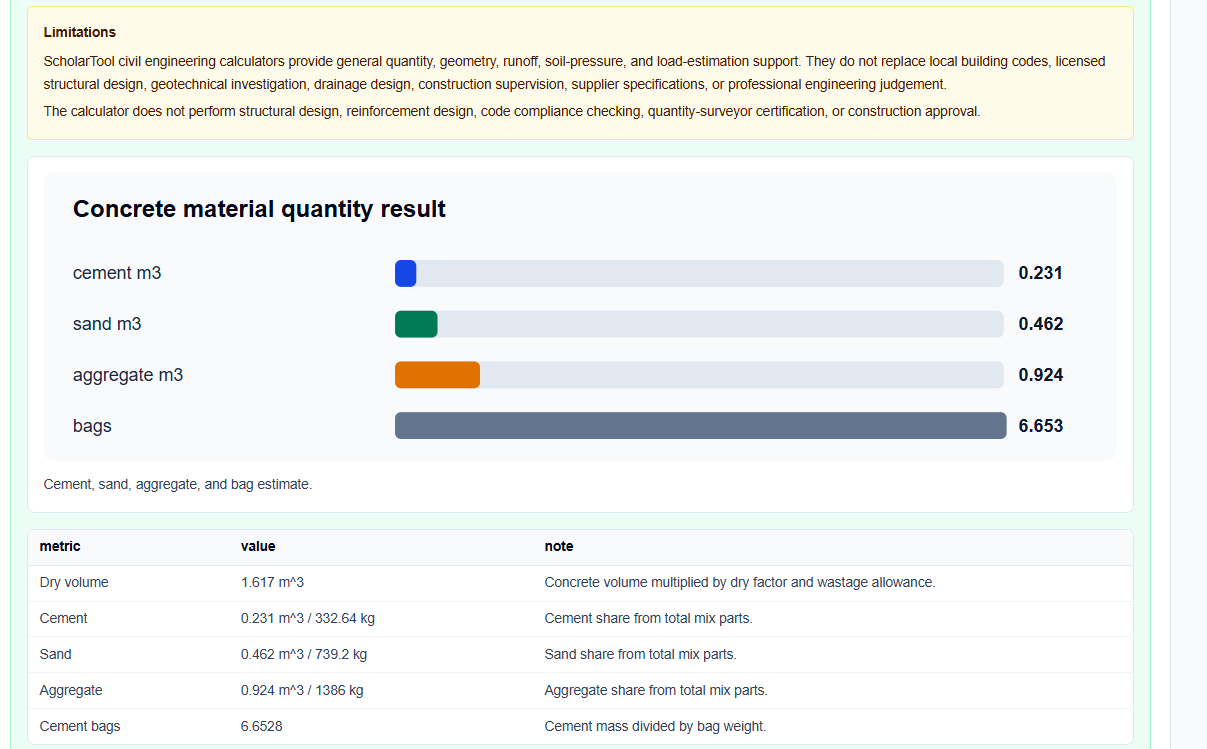
- Dry Material Volume ($V_{\text{dry}}$): The total dry volume needed before splitting: $$V_{\text{dry}} = V_{\text{concrete}} \times \text{dry factor} \times (1 + \text{wastage} / 100)$$.
- Proportional Split: The dry volume is split proportionally across cement, sand, and aggregate parts.
- Cement Bags: Converts cement volume to an exact bag count using bulk density and bag weight.
- Approximate Masses: Converts volumes to masses to help coordinate delivery vehicle limits.
A Practical Example: The Nominal Slab
Let’s look at a realistic nominal 1:2:4 concrete takeoff using a target wet volume of 1 $\text{m}^3$, a dry factor of 1.54, and a 5% wastage rate. After clicking the action button, the tool calculates: $$V_{\text{dry}} = 1 \times 1.54 \times 1.05 = 1.617\text{ m}^3$$.
Splitting this into seven total parts gives a cement volume of 0.231 $\text{m}^3$, sand volume of 0.462 $\text{m}^3$, and aggregate volume of 0.924 $\text{m}^3$. Assuming a cement density of 1440 $\text{kg/m}^3$ and a 50 kg bag weight, the final cement mass is 333 kg, which translates to exactly 6.65 bags.
Mistakes I Would Avoid
A critical mistake is mixing up your dimensional units. It is easy to confuse millimeters and meters on structural drawings. Entering your thickness in the wrong unit system before running the volume takeoff will lead to massive material miscalculations.
Another error is treating these preliminary results as a certified mix design. This calculator does not design for target compressive strength, water-cement ratios, slump, or chemical admixtures. These outputs are strictly for procurement planning and must be checked against a certified mix design.
Try the Free Cement Sand Aggregate Calculator
If you want to streamline your material takeoff and eliminate manual math mistakes, try the tool today. It is free, private, and runs entirely in your local browser.
Try the Cement Sand Aggregate Calculator here.
To complete your construction planning, you can link this estimate into the Concrete Volume Calculator to determine your wet volume, or use the Plaster Calculator for wall finishes.
FAQ
1. Does this tool design or certify a concrete mix?
No. It estimates material quantities from nominal ratios. It does not design or certify target compressive strength, slump, durability, or water-cement ratios. It is strictly a quantity takeoff and planning aid.
2. Why are the densities of the aggregates editable?
Bulk density varies significantly by moisture content, aggregate grading, compaction, and supplier-specific data. Allowing these to be editable makes your batching assumptions explicit and transparent.
3. Why do the results disappear when I change an input?
This is a built-in safety guard. If you edit any dimension or ratio, the results automatically hide until you click “Calculate Material Quantity” again, ensuring you never accidentally copy stale data.